

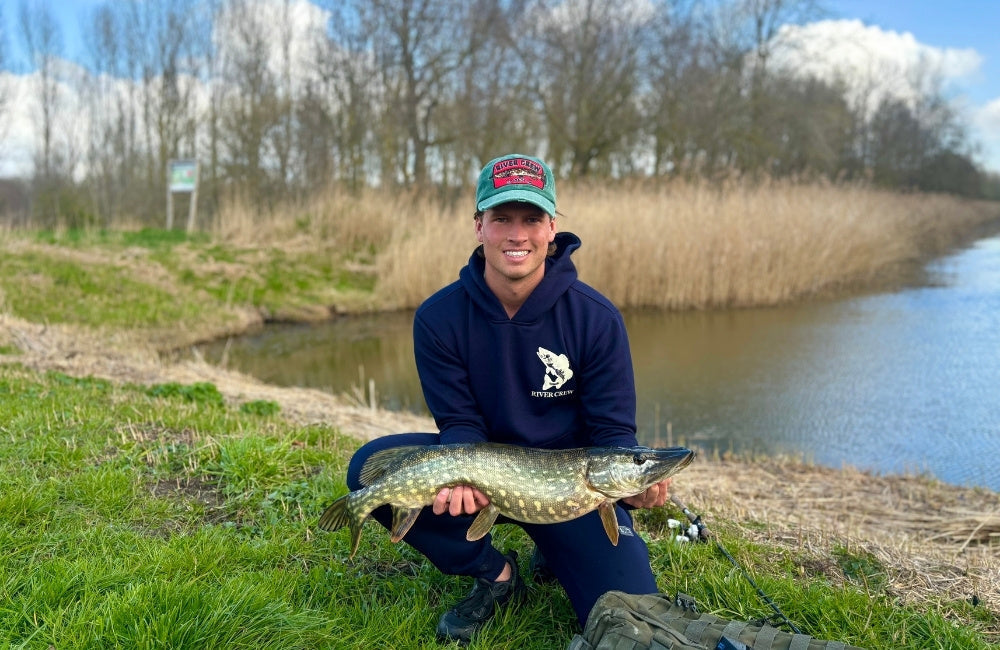
Pike fishing from the bank mainly starts with knowing where to look. Pike like to hide in places where they can ambush prey fish from cover, such as along reed beds, aquatic plants, bridges, culverts, jetties, and embankments. Therefore, don't start with the longest possible cast, but first fish the water directly in front of you and then gradually extend your reach from that spot.
When pike fishing from the bank, it's all about targeted searching. Look for variations in the water, fish at different depths, and don't stay in one spot for too long if nothing is happening. With a few good spots, suitable lures, and a systematic approach, you can effectively fish a surprisingly large amount of water from the bank.
In short: how to fish for pike from the bank
Look for pike around reeds, plants, bridges, culverts, embankments, boats, and other places that offer cover. First, fish close to the bank and then cast progressively further. Adjust the depth, color, and retrieve speed of your lure according to the water and conditions. If you don't get a reaction, move on to the next interesting spot instead of endlessly fishing the same stretch of water.
Where can you find pike from the bank?
Pike are predators that like to hunt from cover. Aquatic plants are important, but a bridge pillar, jetty, moored boat, or small embankment can also provide sufficient cover. According to RAVON, pike prefer clear, still to slow-flowing waters with plenty of bank and submerged aquatic plants.
Therefore, you don't always need to look for a huge or conspicuous spot. A small widening in a straight ditch, a single cluster of plants in a barren canal, or a culvert where two waterways meet can be enough. Also, look for where small fish gather, as pike are usually not far from their food source.
If you want to read more about the species' habitat, check out RAVON's species information on pike.
The best spots for pike fishing from the bank
Which spots are interesting depends heavily on the water you are fishing. A polder ditch requires a different approach than a large river. Yet the same principle applies: look for places where pike have cover and where baitfish pass by.
Pike fishing in ditches and polder waters
Ditches and polder waters are ideal for pike fishing from the bank because you can easily reach many interesting spots. Start near reed beds, bridges, culverts, and ditch junctions. A sudden widening or a dense patch of aquatic plants also deserves a few casts.
Don't just cast down the middle of the ditch. Cast along the bank, parallel to a reed bed, or along the outer edge of a plant bed. Especially in narrow waters, a pike can be practically under your feet.
Pike fishing from the bank in canals
In canals, the bottom is often more uniform, making every deviation interesting. Think of bridges, harbor entrances, boats, poles, side ditches, and sharp bends. The slope from the shallow side to the deeper shipping channel is also a spot you shouldn't skip.
Try not to just cast along the length of a canal. Also, fish diagonally across the slope and let your lure pass through different water layers. This way, you'll get a better idea of where the pike are at that moment.
Pike fishing from the bank in lakes and ponds
On larger lakes, it's harder to cover much water from the bank. This makes spot selection even more critical. Look for sheltered bays, weed beds, edges of lily pads, shallow plateaus, and places where the water deepens quickly from the shore.
The windy side can also be interesting, especially if baitfish gather there. Start close to the plants and then work towards the first drop-off. This way, you'll catch both pike lying in the shallows and fish further out.
Pike fishing from the bank in rivers
On rivers, you don't need to look for pike in the strongest current. Quieter sections are often more interesting. Think of groynes, harbor mouths, backwaters, and areas behind obstacles where the current slows down.
A clear boundary between fast and calmer water can also be attractive. Pike can hold in a favorable position there while prey fish pass by with the current.
How to fish for pike from the bank?
Upon arrival, don't immediately make a long cast. First, fish left and right along your own bank, and then cover the water a few meters in front of you. Only when that yields nothing should you start casting further. This prevents you from disturbing a pike lying close to you with your line and lure.
Then work in a fanning motion. Always change the direction of your cast slightly and also try different depths. For example, let a soft plastic lure run immediately on one cast and let it sink a bit first on the next.
Wherever possible, cast along an obstacle instead of straight away from it. A soft plastic lure swimming a few meters along a reed bed stays in interesting water much longer than one moving perpendicular to it.
Is a spot quiet? Move on. When pike fishing from the bank, mobile fishing is often more effective than casting twenty times in the same spot. A few targeted casts from different angles usually tell you enough.
What lure to use for pike from the bank?
Soft plastics, crankbaits, jerkbaits, spinnerbaits, spinners, and spoons can all be used for pike. The logical choice mainly depends on depth, vegetation, and the amount of space you have.
Soft plastics are versatile. You can fish them shallow or deep, retrieve them slowly or give them some pace. This makes them suitable for ditches and plant edges, but also for embankments and open water. If you want to delve deeper into this, read our guide on the best lures for pike.
Crankbaits are useful when you want to fish a certain water layer. For example, a shallow-running crankbait can be nicely fished over plants. Jerkbaits can be made to dart conspicuously with short movements, and spinnerbaits are interesting when fishing around vegetation and obstacles.
Spinners and spoons are easy to fish and produce a lot of vibration or flash. They are especially useful when you want to actively search a stretch of water.

What lure color should you choose?
In clear water, a natural presentation is often a good starting point. Brown, silver, and other colors that resemble the present baitfish stand out enough without creating extreme contrast.
In murky water or low light, it can be clearer. Yellow, green, orange, and other high-contrast colors are easier to see. This doesn't mean a bright color always catches better in murky water, or that a natural color is only suitable for clear water.
Therefore, see color mainly as something you can switch. If you've carefully fished a good spot without a reaction, a different color or a distinctly different silhouette can sometimes make more difference than ten more casts with the same lure.
What size lure should you use for pike?
Pike can take large prey, but a bigger lure doesn't automatically mean bigger pike. Focus on the baitfish in the water, the season, and the tackle you're using. In a small polder ditch, a more compact presentation might be logical, while in spacious and deep water, a larger lure might be more visibly appealing.
Don't forget the weight. Your rod, reel, line, and leader must match the lure you are casting. With too light tackle, you lose control and make it unnecessarily difficult for yourself during the fight.
When is the best time to fish for pike from the bank?
Pike fishing from the bank can be good during different times of the year, but the locations change. In spring, pike are regularly found in or around shallower, vegetated areas. RAVON indicates that pike spawn between February and May, using shallow, vegetated banks and flooded areas for this purpose.
Always consider closed seasons in spring. In 2026, the closed season for pike starts on March 1st. From April 1st, in many Dutch inland waters, the closed season for certain bait types, including almost all types of artificial lures, applies until the last Saturday of May. Always check the current information from Sportvisunie and the specific water's regulations before you go.
You can find more explanation about this in our blogs on the closed season for artificial lures and where pike are after the closed season.
In summer, weed beds and their edges become more important. Early morning and evening can be interesting times, especially on warm days. Pay extra attention to the fish's condition during high water temperatures and limit unnecessarily long fights and handling.
Autumn is an interesting period for many pike anglers. Baitfish gather more often, and pike move towards the colder months. In winter, fish can become calmer, and it's often worthwhile to fish slower and also include deeper or more stable parts of the water.
Pike lure tips from the bank
- Always fish the water directly in front of you first.
- Cast along reeds and plants instead of just straight away from them.
- Try a different water layer before giving up on a good spot.
- Alternate a steady retrieve with a short acceleration or deceleration.
- Keep moving when a spot yields nothing after a few targeted casts.
- Look for small fish, birds, and surface activity: baitfish often indicate where to look.
- Fish interesting spots from multiple angles.
- Always check your leader and lure after a strike.
What equipment do you need?
Use a spinning rod and reel that match the weight of your lure. A braided main line provides direct contact with your bait and helps detect strikes effectively. Even more important is a robust, pike-resistant leader: pike have sharp teeth, and regular nylon or thin fluorocarbon is not automatically suitable for this.
Always bring good unhooking pliers and cutting pliers. A spacious landing net makes landing fish from a high or difficult bank much safer. If you need to unhook the fish on the bank, a suitable unhooking mat is advisable to prevent damage.
Safe and responsible pike fishing
Make sure your unhooking gear is ready before you start. Once the pike is in the net, you don't want to be searching through your tackle for pliers. Wet your hands before handling the fish and keep the time out of the water as short as possible.
Support larger pike well and don't lift them only by the head or gill plate without supporting the body. Release the fish back into the same water after unhooking and give it time to swim away strongly on its own.
Before each session, also check if you are allowed to fish in the chosen water and what additional conditions apply. The VISplanner is the official digital map with the rules and conditions for Dutch fishing waters.
Common mistakes when pike fishing from the bank
The first mistake is casting as far as possible immediately. That looks active, but you're actually skipping the water where a pike can easily be lying close to the bank. Start close and gradually increase the distance.
A second mistake is staying too long. A beautiful bridge or reed bed might look perfect, but that doesn't mean there's an active pike there at that moment. Fish the spot carefully and then move on.
Only casting into the middle of the water also costs fish. Pike use the edges, plants, and obstacles to hunt. Conversely, you don't have to avoid aquatic plants immediately: their edges are precisely among the most interesting zones.
Finally, many people fish every cast at exactly the same speed and depth. Change something. Let your soft plastic sink further once, slow down near an obstacle, or briefly speed up. This way, you'll discover faster what the fish react to.
Conclusion: pike fishing from the bank
Successful pike fishing from the bank doesn't start with casting as far as possible, but with observing the water carefully. Look for reeds, plants, embankments, bridges, culverts, and other anomalies, and always start close to your own bank. Then fish systematically further and adjust your speed, depth, and lure if you don't get a reaction.
When pike fishing from the bank, moving is at least as important as casting. Fish a good spot from different angles, but also dare to walk further. With a few types of lures and a clear approach, you can easily fish ditches, canals, lakes, and even parts of rivers from the bank.
Would you like to compare different colors and soft plastics side by side? Then check out the River Crew lure collection. For long days along ditches, canals, and lakes, you'll also find our fishing apparel.
Frequently asked questions about pike fishing from the bank
Where do pike sit from the bank?
Mainly look around reeds, aquatic plants, bridges, culverts, jetties, boats, and embankments. A small deviation in an otherwise uniform water can already provide enough cover for a pike.
What is the best lure for pike from the bank?
That depends on the water and conditions. Soft plastics are versatile, while crankbaits, jerkbaits, spinnerbaits, spinners, and spoons each have their own moments. The most important thing is that your lure can be controlled well at the desired depth.
How deep should you fish for pike?
There's no fixed depth where pike always are. Fish different water layers and pay attention to plants, embankments, and baitfish. In shallow, vegetated water, pike can be just below the surface, while in a deep lake, they might be deeper.
What is the best time to fish for pike from the bank?
That varies by season and weather conditions. Morning and evening can be interesting, but pike can also become active in the middle of the day. Spot selection and finding baitfish are often more important than just the time of day.
What color lure works for pike?
Use natural colors as a logical starting point in clear water and more conspicuous colors when the water is murky or there is low light. Keep switching if a good spot doesn't yield a reaction.
Can you catch pike in a regular ditch?
Yes. Pike are found in virtually all types of water in the Netherlands. Ditches with reeds, aquatic plants, culverts, and sufficient prey fish can be good pike waters.
Do you have to walk a lot when pike fishing?
From the bank, mobile fishing is often an advantage. By fishing multiple interesting spots with a limited number of targeted casts, you'll find active pike faster than if you stay in one spot for hours.


